What is the difference between cropping & framing?
What I see as the difference between ‘cropping and framing’ is; Framing can be described as a conscious decision as to what to fit into an image, whereas cropping is a decision as to what to remove or leave out of an image (subject to whether this process is pre or post shoot). To ‘crop’, is to take away. To ‘frame’, is to encompass. Framing is something which intuitively takes place before the photograph is taken, whilst cropping is mostly done after the image has been captured. By shooting ‘the bigger picture’ which includes as much information as possible (within reason), you allow yourself the chance/choice, post shoot, to alter many things about the image, and how it is read/interpreted. It could also be said that both are conducted before the photograph is taken. I good photographer should know instinctively what it is that he wants from a scene and be able to see what he wants through the viewfinder. I also think that cropping is probably a lot easier, or in fact more an integral part of making an image when shooting with a large format camera. The process of constructing an image naturally takes more time. I’ve heard it said on many occasions by professionals that have moved across to large format, that it is a slower process, and therefore the cropping does become part of the ‘pre-shoot’ process.
Having said that framing takes place before the shot is taken, if cropping then takes place afterwards, what then is the difference, given that, by cropping, you are by definition altering the frame/content of the image and even its meaning. Sure, it is better to get it right ‘in-camera’, but a very good defence for post shot cropping would be in the case of portrait photography. You (normally) get one chance or sitting with the subject. It is said that a good rule of portrait is that a part of the head (back or top) should be cropped. To get it just right, it is definitely better to include all of the head and decide how much to crop later. Just a little cropping one way or the other could make a huge difference.
Although not exactly the same, but equally as important, the term ‘Framing’ extends to the dimensions used to encapsulate the subject matter. This will initially be determined by ‘in camera’ settings, but can then be cropped at a later date to better suit/balance the contents of the image.
Having been able to study Walkers’ American Photograph, it is there for all to see that his ability to frame a scene was second to none. The cropping is very well done in part one. In part two, given the general nature of the images and tight framing, there is little need for cropping. Even ‘Plate 29’, although clearly cropped, doesn’t feel like it has been. I think this is because the cropping is so tight and he has cropped along the obviously ‘natural’ lines. It has also been made easier to crop because the image has been shot ‘face-on’ (as he often does). Interestingly, in the following plate, in the bottom right corner there is the bonnet and from wheel of a car! Why is this? Why didn’t he get closer to the buildings, thus still giving him the ability to balance the image? I also find that ‘Plate 37’ gets me asking questions of my own photography. Here he has cropped it very tight on the bottom and both sides. With shots like this, my default is always to ‘shoot more’ and get everything, I can always crop later. For me, this image feels incomplete!
‘American Photographs’ was a road trip, documenting the diversity and contract throughout the U.S, and as such was much more analytical/critical/clinical, and was concerned less with the artistic side of photography and more with the recording of information. I think he would see what he wanted first, then build a frame around it (much easier to do when taking portraits). That said the work of the ‘artistic’ photographer is in some ways harder given the attention that needs to be paid to the balance, composition and structure of an image. With all of these factors to consider, things necessarily need to be cropped out of a photo to make it balance or sit well.
In summary, it may be that Evans’ cropping ability is so good that in recollection, I don’t think that he does a lot of cropping. Maybe this is the lesson to be taken away; If your eye for framing is good then you don’t need to crop. This may also carry through to ‘the photographer’s eye’, if that is good, then cropping is not a necessary part of the process. Or more accurately, is done subliminally, and when done correctly is not noticed by the viewer. I know that looking back historically through my own work, as I have improved and got more of a feel for what feels right, the cropping has improved and is much less obvious in my work.
For the first part of this exercise I went out and shot lots of images of signs. I tried to make the shot of each sign in a random section of the three by three grid superimposed on my viewfinder, paying no attention to the surroundings/composition. It proved to be very difficult , as I almost always knew instinctively where it should go, and therefore would have to exclude that part of the frame from my ‘random’ selection!
Here are my reviews of some of the shots I took.
 1
1 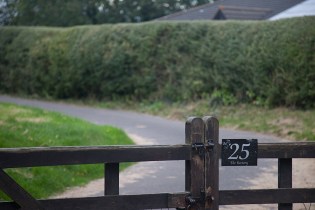 2
2  3
3 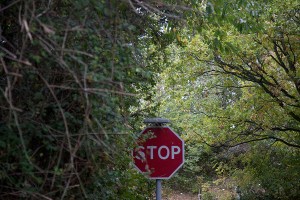 4
4  5
5
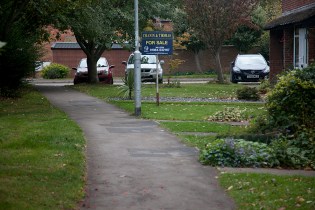
Signs are things that usually relate to something quite close by, and so when it comes to positioning them within a frame, there are often not very many options. The one that works the best normally stands out from the rest very clearly. So for example, image one is a ‘For Sale’ sign for a house. There are normally only two type of image you would see for this sign, and they are the one where the focus is on a line of boards in sharp focus with (possibly) the houses (slightly out of focus) behind them. This is usually to portray how bad the current housing market is (i.e. people are not buying at the moment). My image shows the sign in the upper middle position, surrounded by garden and cars. It does not show the house it is pertaining to! If i took the shot again, I would reposition so that the sign was possibly in the bottom left, therefore giving full view of the front of the property that was for sale! As a point, it doesn’t work, because it doesn’t stand out particularly and it is just lost in a messy photograph. Image two shows a house number on a gate. The information is all low down in the image and really, the image needs reframing so that there is more to see of the gate, because, somehow the gate and the number are all one thing. Even though the sign isn’t a point like we have been looking at in previous exercises, it is the thing in the photo that draws your attention straight away, however it is set within a series of parallel lines and the eye feels stuck at this point and has to fight to travel along the path and through the image. Image number three has two problems that are related and both solved by the repositioning of the lens. There is too much sky and not enough of the building (that said, it is an unusual angle and does actually work as a stand alone image) here. If the image was re-shot with the pub sign in dead centre or top right then i think the image would be better balanced. The sign itself does have a ‘point’ as such and I think that this is what gives the image some kind of stability and makes it work. With image four, it is all about what you are used to seeing. Almost all road signs are up high so that everybody can see them (even from a distance when, perhaps, the car in front is blocking a lot of the view. So to position the sign in anywhere in the bottom third of the frame is counter-intuitive, especially when it is surrounded by foliage! The sign acts as a point within the frame, but within the rest of the frame there is nothing else, and so I feel the positioning of the point is crucial. A rare occasion when ‘a point’ needs to be positioned correctly for it to work! In image five, the sign is in the top left corner. The whole photo has a comfortable feel about it, and i think that this is because the ‘point’ is strengthened by the diagonal lines that point to it and beyond, so the sign is an integral part of the image.It also helps with the strong upright lines of the post being one-third into the image too.
Exercise 1.4 Frame. (click here)

These images were all taken with my Canon 5d MkII camera and 24-105mm lens. The camera was still set to fully auto. Moving clockwise, starting top left, the settings are as follows; 1/80 @ f4.0 ISO 250, 1/60 @ f6.7 ISO 800, 1/80 @ f4.0 ISO 1000, 1/125 @ f4.0 ISO 500, 1/100 @ f4.0 ISO 800, 1/60 @ f4.0 ISO 320, 1/100 @ f4.0 ISO 1250 and 1/100 @ f4.0 ISO 3200.
The idea here is that this collection of eight images are selected, arranged and observed with the intention of it being a single image, rather than a collection in the way you would visit a gallery. The images were all taken from a selection whose overriding theme was that of concentrating on just a small area of each image, and composing it with disregard for the rest of the image. By thinking about how to make these images sit comfortably within the same frame I am having to concentrate on the form of the overall single image. That is to say that I have tried to create structure and give cohesion to achieve a single harmonious image. My general idea was to link them by use of direction implied by either leading lines or actual arrows. I think that I have to a greater extent achieved this.
 I see!