Project 2 Reading pictures
3rd May 2021
Research Point

Insomnia, 1994, Transparency in lightbox, 172,2 x 213,5 cm, courtesy the artist © Jeff Wall
Sharon Boothroyd (OCA tutor) uses some of the tools listed below to deconstruct this well known image as she sees it. It is important to remember (as with all interpretations) that this is her reading, not the reading, not the single correct reading.
My observed denotations:
- Location- Kitchen.
- Cooker/oven.
- Fridge/freezer.
- Bag on top of fridge.
- Unkempt.
- Shutter over window.
- Reflection of ceiling light in window.
- Man laying awake under the table, bare foot..
- Man is clean shaven (Has a tash & goatie)
- He is not malnourished.
- Some cupboard doors open.
- Two chairs.
- Teat-towel on chair.
- Table with ashtray and salt cellar.
My concluded connotations:
- The man is in some distress.
- He lacks financial wealth.
- His lifestyle is unhealthy.
- He has been searching for something, possibly food.
- The room is cold.
- He has shut himself away from the world outside.
- He needs help.
- The room smells damp/dirty/greasy.
- He lives alone.
- His mental health is not good.
My burning question is; Why is he lying under the table. He has got under there on purpose, but why. If it were for security or comfort (a defence of some sort), then surely you would hide under a duvet. Perhaps this signifies that hours of insomnia in a bed are just to painful/daunting for him to contemplate. Does the thought of going into the bedroom to try to sleep have so many bad connotations that he would rather, in desperation, lay on the hard floor, under a table that provides nothing emotionally comforting (warmth or proximity)?
In The photograph as contemporary art1, Charlotte Cotton tells us that ‘the angles and objects of a kitchen scene directing us through a picture and leading our understanding of the action and narrative’. Wall has created a story, and left us clues to try to interpret what has brought him to this point at which Wall has ‘captured’ the moment in time. In reality Wall has used a production team to assemble all of the contributory components to set the scene exactly as he wants it.
Much of Wall’s work is in a very large format, and this one is no exception (172.7 x 214 cm. (68 x 84.3 in.)). Of the presentation, ‘his works are made through the use of see-through cibachrome, later assembled and exhibited with a light box. That confers to each work a status that goes beyond the steadiness of the shot to look more like a movie still frame’2. The presented size of this work allows for us to really’ get stuck in’ and see the detail, read the clues.
I think that Wall’s work is so packed with ‘sensory abusers’, by which I mean, upon seeing this image, not only are our eyes bombarded with information, so rich is it that I feel as though I can smell the dank, staleness of the room. My ears can hear the ringing silence, punctuated by the fridge cooling fan coming on. My finger tips almost itch with the touching of grease and grime, built up over a long period of neglect. So much so that when trying to read or interpret this image, I am often misled by many of the denotations, being duped into describing what they connote. Distilling denotations from what they connote requires a lot if discipline.
27th April 2021
In many ways these images are very similar to the works of Gregory Crewdson, only more distilled, perhaps easier to read.
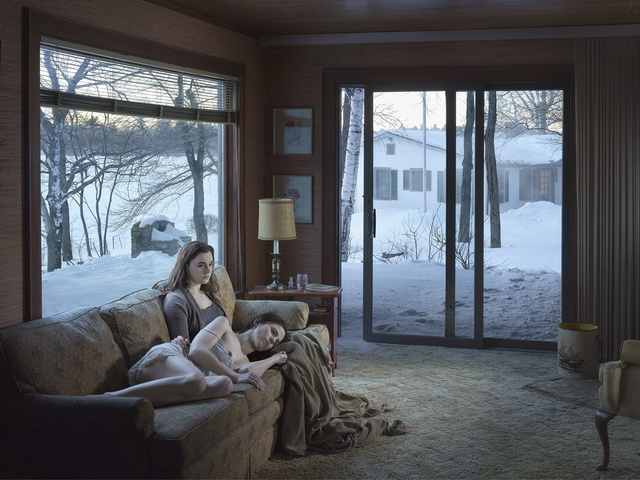
Mother and Daughter (2014)
© GREGORY CREWDSON, COURTESY GAGOSIAN GALLERY
REFERENCE
- Cotton, C. (2014) The photograph as contemporary art. Page 50-51. London: Thames & Hudson ltd.
- The Blogazine. http://www.theblogazine.com/2013/03/jeff-wall-actuality/ 25/03/2013
25th April 2021
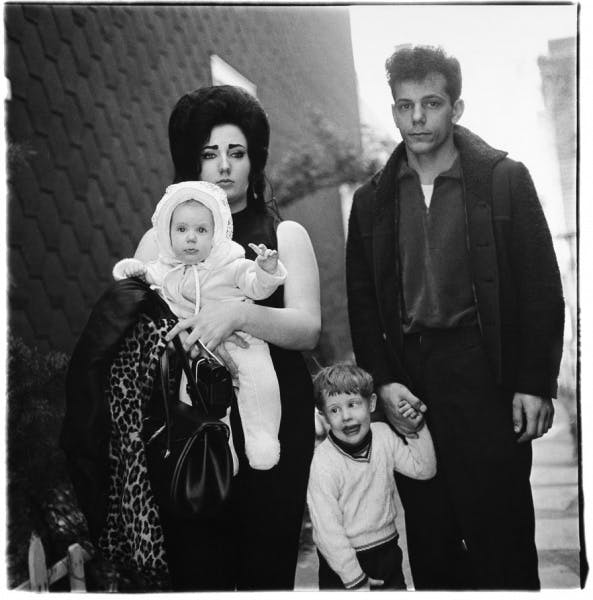
A Young Family in Brooklyn Going for a Sunday Outing. Their Baby is Named Dawn. Their Son Is Retarded. Diane Arbus 1966 (printed 1971)
In Singular Images: Essays on remarkable Photographs by Sophie Howarth (2005, London: Tate Publishing) there is a chapter on Diane Arbus, in particular, the image above (https://www.oca-student.com/sites/default/files/oca-content/key-resources/res-files/ph4can_singular_images.pdf ).
Read & reflect upon this chapter: I had imagined that this was a more candid shot, almost as if the couple had been ambushed, a photo requested, and quickly taken, to give some essence of spontaneity. I now know that Diane Arbus had been with them earlier in the day, at their home where she had made a portrait of them in their home.

Diane Arbus: N.Y.C. Young couple on couch with children. 1966 Mother on a couch with her baby on her lap, Bronx, N.Y., 1966
Gelatin-silver print
9 5/8 × 9 3/8 in

What strikes me straight away is that in both images he is looking at the camera, and she is not. In the third image when she is the sole focus of the camera, she is still avoiding looking directly at the camera. In this image the connotation of her sad demeanor is amplified by the fact that she is alone (with her baby), yet still appears to be in a place far from where she actually is.I feel as though she is making a point of looking away. Roland Barthes talks about the external components/persuasive that help us to understand an image more clearly. For instance, if an image is in a certain publication, it will be a) read by a particular demographic, and therefore generally interpreted in a certain way, perhaps a political sway, and b) possibly accompanied by different wording or titles. With the emergence of this earlier image, I strongly believe that the body language is more ‘As is’, by which I mean; He looks to be the more subservient of the two, she has a much stronger air of matriarchal presence and strength. Having seen there street image, I was happy to believe this was merely a fleeting, unguarded moment, but now I think that their body language is a significant connotation of the structure of their relationship. I read this connotation as she resents him and blames him for the birth of their “retarded child”. I agree with Liz Jobey (the writer of the chapter/article) that she also is resentful of her husband for not providing her with the surroundings, trinkets and baubles that she feels she was somehow entitled to (possibly brought about by her childhood dreams), though they both have a look of resignation and defeat about them. Arbus distills and encapsulates their life in a single sentence; “They were undeniably close in a painful sort of way”. For us the viewer, we have three images in which to understand what Arbus meant, yet it is so sadly apparent. Two people, two halves of a whole, both wanting something better, yet neither can live without the other, like a lame man cursing a crutch, yet take it away, and he cannot walk! In each of the three images this can be seen if we only focus on the heads!
For me, the punctum within the image is very subtle and often overlooked (which is odd, given it’s standing within the image). The camera that she is carrying! The images that we have of her suggest that she is existing (with regret) rather than living, devoid of emotion, not even her young child seems to register anything within her. Yet they are taking the camera out with them, presumably to record the ‘happy times’!
I think that overall, Jobey is presenting a very balanced view or insight into the workings of Arbus’ mind. It is very easy to get hung up with the way she ‘exploits’ the ‘freeks’, after all this is what you could be forgiven for saying if you were summing up her work. Jobey however covers many subjects, and not in a timeline that just spouts information. Jobey starts with an in-depth look at the Brooklyn family image(s), but never wholly in an analytical way, she offers us tasters and morsels to get us to explore for ourselves. This can be said for the whole article in general. It can be so easy to get drawn in to explaining what a person genuinely believes, whilst forgetting that they don’t really know what the image is about, it is all pure supposition, I don’t think she ever loses sight of this.
Sontag’s thoughts (I think) are all really quite contentious, but Jobey puts them out there, and then balances them cleverly with the thoughts of John Szarkowski, who delivers a much more ‘under the skin’ interpretation. After this balancing act, she somehow comes up with the stroke of genius to then add a quote from Arbus which is really saying that it doesn’t matter what these two renowned individuals are saying, this quote is from the horses mouth! Thus putting everything into perspective. This is then followed by her own thoughts which contain words like ‘perhaps’, letting us know that what follows are just musings, possible ideas being thrown out there. And what a great thought it was too! The thought that, having agreed to be photographed, when it comes to the act, they have this realisation that (In particular Marylin) they are playing out a persona, somebody that they want to be, somebody that they aspire to, but in the moment of truth in front of the camera, they realise they aren’t up to the experience. This fragile eggshell of a defence/disguise is suddenly shattered. The last remnant of what is keeping them alive is hope!
Towards the end of this piece Jobey leads us to another image of the same couple and extensively denotes what we see, but resists the temptation to give us her connotations of what this image may say in addition to the former.
17th April 2021
Tools for deconstruction
Sign = The overall effect of an image.
Signifier = The actual picture, its formal and conceptual elements.
Signified = What we think of when we see the picture. This could be what what comes to mind first off, our feeling for the image.
Sign = Signified + Signifier
Interpreting an image: We can interpret a photograph on two different levels.
Denotation = Translation. Understanding the things that are actually in the photograph.
Connotation = Interpretation. Understanding an image based on the meaning, or representation, of the items/elements within the image. This can be very subjective.
Punctum = Something that doesn’t sit right with everything else in the image, the curved ball, the element that forces you to either rethink, or question what you see.
Studium = The photograph’s cultural, political or social meaning. Something stronger and more direct than a signifier.
Intertextuality = The fact that we all interpret a single image in a different way. This is governed by our own experiences in life. The more we can draw upon to interpret or translate an image, the richer it becomes. Barthes likens this to a tapestry or cloth that has been woven. The more colours and directions of thread, the more interesting the article becomes. By reading other peoples interpretations, with an open mind further enriches our view of an image. We don’t have to agree with the interpretation, but by understanding why they see an image in a certain way should broaden our own mind and open it up to accepting different ideas, possibly encouraging us to view things in other ways to our own initial presumptions.
Photography is one of those subjects that has a foot in both the camp of science and art! On a fundamental basis we can say that the science is in the developing of an image i.e. the use of chemicals and the whole process of bringing an image to paper/screen, and the art is the skill of framing and bringing effect to bear. However, the division runs deeper. Within the ‘taking’ of the photograph, we can roughly, subdivide it into two categories. That of (loosely speaking) media and delivery of information, and that of art, fashion and styles (of photography). Although the very nature of photography does not allow for it to be totally transparent, we would say as a generalisation that we are able to translate the former, whereas we would have to interpret the latter.
11th April 2021
Deconstruction
Jacques Derrida (B 1930, D 2004), the father and founder of the line of philosophy known as ‘deconstruction’.
In line with many ‘themes’ of philosophy, personally I find that concepts are always taken to a degree of abstraction and then one step further. I think that it is for us as individuals to be able to realise where the line has been crossed, take a step back, and use all the information from that point and backwards to create logical formulae and structure from which all can work. We have to work theories and concepts beyond the point of reason, to find the line at which things break down, so my thoughts on the development of a theme are not a criticism, merely an observation.
I believe that Derrida did just this. He took the literary philosophy of ‘Structuralism2‘ and distilled it further and applied it to photography (calling it Deconstructualism). The combination of two very fluid ideas/medium have made it almost impossible to come up with anything concrete (which may have been his aim) ways of reading an image. In doing so, understandably, he made his theorem very controversial. He basically gave an ‘anything goes’ rule! He gave a medium that was/is already vague and open to interpretation, a guidebook to interpreting, that was in itself open to interpretation!!
In short, “As a result it can be argued that it is impossible to know what anything means. … Conceived as a means of analysing language it is applied to photography, although in doing so an extra layer of complexity is introduced as a photograph does not have an arbitrary relationship to the thing it represents.”
To better understand this, we need to know the basic premise of Structuralism. Structuralism was developed in the early part of the last century by the philosopher Ferdinand de Saussure. His theory (closely related to the work of Roland Barthes) states “…things, text and images etc. do not have meanings in themselves; they need to be decoded to understand their deeper structure.”3
From my own personal stance, I can understand and give credence to Derrida’s work if it wasn’t anchored to or by Saussures work. As a stand alone concept, it is plausible and indeed workable, but could you invest in ‘Houses that are built upon the sand?’
- Derrida, Jacques. The principle of reason: The university in the eyes of its pupils. The John Hopkins university press. Baltimore, Maryland. 1983. Translated by; Catherine Porter and Edward P. Morris
- Grange, Ashley la. Basic Critical Theory for Photographers. Focal Press. Elsevier Ltd. Oxford. Pg 238
- Grange, Ashley la. Basic Critical Theory for Photographers. Focal Press. Elsevier Ltd. Oxford. Pg 150
Project 1 The language of photography
30th March 2021
I can’t help but feel that I am being patronised in my coursework here. This is very unusual, as the whole point of the course is to teach us to NOT accept what has gone before, or at the very least, think about and question, ney, challenge what has gone before. However, here I feel that I have to accept that Alice is right, and Humpty Dumpty is wrong! Alice may be right, but Humpty Dumpty is not entirely wrong. It is he that provides the ‘grey’ area, the area that forces us to think deeper, beyond the accepted. When I substitute words that are buried too deep for me to recollect, I am able to substitute them for completely random words (Reggie Perrin substituted ‘tray’ for ‘earwig’ yet we were still able to understand the meaning and intention of what he was saying!), and although not all, many people are able to not only follow what I am saying, also find humour in my choice of words. To me this shows that Dyslexia is transcendental. Not to mention, falling on the side of Humpty Dumpty’s argument.
The last line on the subject of Alice/Humpty, is as important as anything that is written before; ‘The idea of language being malleable is nothing new.’
I can’t help but feel thatI am being patronised in my coursework here. This is very unusual, as the whole point of the course is to teach us to NOT accept what has gone before, or at the very least, think about and question, ney challenge what has gone before. However, here I feel that I have to accept that Alice is right, and Humpty Dumpty is wrong! Alice may be right, but Humpty Dumpty is not entirely wrong. It is he that provides the ‘grey’ area, the area that forces us to think deeper, beyond the accepted. When I substitute words that are buried too deep for me to recollect, I am able to substitute them for completely random words (Reggie Perrin substituted ‘tray’ for ‘earwig’ yet we were still able to understand the meaning and intention of what he was saying!), and although not all, many people are able to not only follow what i am saying, also find humour in my choice of words. To me this proves that Dyslexia is transcendable.
29th March 2021
I have taught myself to make light of, or go with the flow of my Dyslexia. To this end, if I am unable to think of the word that I need within a normal space of time, I use a completely random word which somehow comes to hand. If the word is completely abstract and totally unrelated to the intended word, I find that people are often more able to guess or fill in the missing correct word more so than if the replaced word is too close or associable with the general subject. I find this to be very interesting. Reginald Perrin was very good at this too2. This is a classic Reggie-ism, which is obviously misunderstood in the episode, for laughs. However it does go to show that even if written/oral language is ‘translated’, there is still fun, manipulation and intended ambiguity to be had within the seemingly rigid and structured world the written word. Indeed, here is the stepping stone to which we arrive at photographic ‘interpretation’.
So, can the same then be said of photography? i.e. Can some or all of the components of an image be so out of kilter with the rest of the image that they actually become easier to read than something which is ‘so near and yet so far’ from the overall point? I think it is safe to say that this is not the case. And in saying this, I turn the argument on it’s head! Hence, an image can/indeed is inherently ambiguous and subject to interpretation, however, If it is the intention of the image taker to encourage the viewer to ask certain questions within the confines of an ‘area’, then the taker cannot afford to be ambiguous with his/her ‘mise-en-scene’.
25th March 2021
Departures
We have to accept the fundamental fact that photography is a type of language before we can go further. In doing so, it allows us a datum point as it were, something from which we can work upon, a foundation on which we can build. If we use this analogy, we can say that whether you are building a skyscraper or a log cabin, the basics are the same. This is not to say however, that the techniques and minutiae are the same.
Where words accompany an image, we have to remember that word can be emotive, and can be even more beguiling when used with other words. For example; ‘The figure, shrouded in darkness, cast a menacing shadow that reached out to his intended victim’, can also be, ‘The man standing in the dark, cast a long shadow’. Both sentences say exactly the same thing yet the way it is composed and the words that are selected give a very different impression. Words are fundamentally ambiguous, whereas a photo cannot lie in its presentation. Where this gap is significantly bridged, is in the mind of the reader of the image. No matter how imaginative the viewers mind is though, the origin of the thoughts/interpretation will always stem from what is seen in the image. That is to say, the image/content is always the source of the minds ‘journey’. It refers to the subject, as an inescapable link.
It is imperative that we always remember that just because we call photography a language, unlike the language of words, photography is based on interpretation, not, translation.
Our course work gives a great example of how words within the written language, projected orally can be laid open to interpretation, or in this case, ‘put out there’ with that very idea in mind, to mislead or confuse1.
- Belsey, Catherine. A Very Short Introduction to Poststructuralism, Oxford University Press. Oxford. 2002.
- https://www.dailymotion.com/video/x5jxh1l Minute 28:20. The Fall and Rise of Reginald Perrin S01E07 – The Memorial Service.
 I see!