Project 3 Self-absented portraiture
23rd to 25th March 2021 assignment 3 rethink I found this an extremely difficult assignment to complete. Writing the diary, I really wasn’t happy with myself or the world around me at the time. As a result, my diary entries were ‘colourful’ at times. Having decided to use the idea of putting myself into some of my favourite album covers that best reflected some of my moods & circumstances, I slowly realised as I progressed, that what I was doing was shoehorning ‘nice’ ideas into the assignment solely based on them being a good idea rather than being of relevance. This coupled with the time I needed to spend in Photoshop (learning on the job) to produce the desired effect was extremely frustrating. The further I went down this production line, the more I felt committed and unable to cut my losses and start again.
Having read through my tutor’s extensive comments, and got an overall feel for what he was saying, I concluded that there were too many faults with this submission and so the assignment needed a re-think. My Photoshop skills are not up to the required standard, and my working knowledge of Photoshop techniques are insufficient. Finally, many of the ideas moving from the idea stage to the finished presentation were too tenuous.
I have re thought the assignment brief, and, by still using the original diary entries, have come up with a completely different idea. This is very risky, as I am unable to submit it to my tutor for his advice.
New Idea
I am going to use my face as the canvas, ‘white-up’ and paint my feelings (based on diary entries) onto my face. I will also invite my family to use the canvas too.
Things to portray.
I eat too much/am over weight. Blow out cheeks and emphasise, or paint food on cheeks/around mouth.
Drink too much. Paint bottles, glasses.
I’m quick to laugh. Paint upturned mouth on a downturned mouth (dual or false persona).
I’m grumpy! Frown lines, eyebrows.
My aspirations; Climbing, new business (numbers/sums etc), to be a good father/husband.
My Dyslexia. Paint ‘D’s & ‘B’s & ‘d’s & ‘b’s on my face.
Some reference to Pink Floyd ‘Keep talking’. U2- ‘Stoop so low to reach so high’, ‘From father to son the blood runs thin’.
27th May 2021
Rethink
Something just isn’t right. There are some good ideas here, but even if they were brilliant ideas, they aren’t as close to telling me who I am as anything music driven does. I’ve got to stay true to what drives me……. I’m going back to my original concept!
Tutor is right about the ‘Strolling Bones image, it is not a job well done! In retrospect, I now think that I wanted to put any Rolling Stones image in, just to say “I like The Rolling Stones”. Even though I’ve seen them many times, and love so much of their music, it isn’t an inherent part of me. I eat ‘Bounty’ bars almost every day, but they don’t define who I am!
Yes, I’m happier now, maybe not happier, perhaps more at peace, I’m going back to the original images.
Problem: By doing this it avoids/ignores so much of my Tutor feedback!
There is a sort of mental juxtapositional fight going on here! I feel as though I have to fulfil certain criterial obligations, but then these take me away from producing ‘self-portraits’ that are me, and more towards a series of images that have been shoe-horned into ‘tick-list’ of conformation.
This is by far and a way the hardest assignment i’ve done on this course.
Go with your gut instinct, do what you think is right Miles. GO WITH YOUR GUT!
Exercise
13th & 14th October 2020 Washing-up. By Nigel Shafran. Let me start by asking; If this body of work had been produced by Miles Butteriss, OCA student, would it have received the acclaim and accolades that it has? Given that it was produced by renowned fashion photographer, turned fine art photographer of Tate and V&A fame, I think not! For me this epitomises where we are today in the world of photography. We have spent the first 150 years exploring what can be created using, broadly speaking, photographic techniques and subjects. Then when the interesting subjects and ideas were photographed to death, and there was nothing was left for the lobotomised to record, they started to tell us about the kings new clothes! And here we are. Soon, if it hasn’t been done already, some budding Tracey Emin or any one of the YBA ‘sect’ will be compiling a collection of images of their faeces, ready to to hang on the walls of some gallery of great renown, proclaiming profound insight into life itself or some such jibber jabber. The collection will then be sold at a great auction house to a multi millionaire who is unable to see beyond what he is being told he is seeing. Thus, said ‘artist’ will be set up for life! THIS IS BULLSHIT! AND I DO NOT ACCEPT IT. I REFUSE TO ACKNOWLEDGE THIS AS ANYTHING BUT SELF INDULGENT CRAP. SO! Let’s do the exercise: Right now, there is nobody left to watch the performance on the band wagon: Because, everybody and his dog has jumped on it! Everybody is looking to be either a ‘poor me’ minority or a ‘I’m the equal of everybody’ majority. The fact that this series was taken by a man has no relevance whatsoever (unless you are sad enough to be a man who is trying to tell the world “men do washing-up too, you know”). I can understand why the question was asked. It is because the greater number of homemakers are still women, this is a fact, and until it becomes a distant and outdated fact, then assumptions like this will be made. ‘Does gender contribute to the creation of an image?’ This is an ambiguous and open question, designed to stimulate discussion. YES- Women have different ideas and ideals from men, they see different things in different ways, they have different subjects that are more important to them than men. No- A man and a woman are both capable of sharing the same interests, ideas and motivations. If absolutely nothing else, Shafran’s images show this. By not including people within the images, this series achieves what? Does it try to make the statement that doing the washing up is gender neutral task? Is it trying to trick us into asking what we imagine the woman to be like that works at this work station? How devious! Interesting ‘Still life’ compositions? – One of them; Yes. Two or even three, OK. 170 of them, No. No, no, no! I have looked at countless ‘WordPress’ blogs by OCA students today, and every single one, without fail, has towed the party line, spouting subservient, mindless drivel. WAKE UP, SMELL THE COFFEE AND THINK FOR YOUR F*****G SELVES!!! Regarding Anna Fox’s ‘infamous’ Cockroach Diary; She was recording a particular era/time in her life, this is what we often do, this is after all the premise of a diary! The conclusion the author (of Project three) presents to us the student, is that in isolation, Anna Fox hasn’t seen the need to include herself in the pictures that she took to accompany her diary. I would see it a more strange if she had included pictures of herself! Explain why!- Why? Because diaries are a record of what goes on around the person, a diary doesn’t need pictures of the author to anchor its trials and tribulations, the authors thoughts written straight to page are doing this sufficiently. Pictures of oneself are like captions under an image, stating the obvious. Wholly unnecessary and serve to detract from the body of work itself. NOTE: Why is this work being called ‘Self-absented portraiture? It isn’t! Surely it is autobiographical…… at best! I have just been to the website of Maria Kapajeva and sadly, it left me bereft of feeling, feeling for anything. I say sadly, as having read about her involvement with the ‘Fast Forward’ UCA collaboration, I really wanted to be inspired and get on board with the promotion of women in photography (Or lack of). I wanted to see the injustice rammed in my face, but I didn’t. I was left with a sense that (in particular) her work was over egged to a point of being beyond both my comprehension, and subsequently my threshold of attention to dig deep enough to empathise with it. I am not saying that she was trying too hard or even trying to be ‘abstract’ in what she was producing, I just felt extinguished by her work. It is true that the amount of male to female photographers out there is disproportionate (I’m saying this, but I have no data to reinforce this ‘fact’), and IF this is the case then surely it cannot be backed up by saying that it is because men are somehow, genetically of a better predisposition to take a better photograph than women. This cannot be true, fact. So we must believe that it is because of a ‘Boys club’ culture that must exist within the industry? For me there is some kind of parallel to be drawn between this & Women in the sports of Darts & Snooker. Neither of these three activities are reliant on the physicality of the male form, yet in neither sport are women anywhere near the top of the tree. Why? And does this extend into the realm of photography? The answer is No! There are female photographers, both past and present that have been and are up there producing work equal and often better in all criteria than that produced in the equivalent field by their male counterparts. I don’t know what the answer is, but I don’t think it is a question of opportunities.
12th September 2020 Project 3 Self-absent portraiture Sophie Calle again! I struggled with her body of work in Part 2, addressing Post Modernism. NOW, we are told to assume that it “transcends the genre of self-portraiture”! So this suggests that at some point we are accepting that it was, at some point, self-portraiture, or at the very least had some connotations thereof. Unbelievable!
Project 2 Masquerades
2ND March 2021
And Oh how he tried!
I was too young to realise that it was weighing me down and holding me back, I’d attributed my demeanour to other things. In hindsight though I realise that this was just one of a number of millstones around my neck. I was able to shrug it off though (the moment I left school!), thus lightening the burden of other weights, and allowing me to grow and develop in adulthood.
I have already reverted to the use of a fountain pen, except not with an italic nib, and certainly not the conventional & standard issue ‘right handed’ nib. That said, I still love the sound of the scratching of the nib on paper. What I had forgotten was how (Only lefties will recognise this) the nib used to annoyingly dig in when you were pushing the flat ‘bladed’ italic nib instead of dragging it. I still got my hands and fingers covered in ink somehow, although some of it was deliberate to recreate the mess that I would always make on the paper. As a leftie, your writing hand was always dragging across or dangerously near to wet ink, which was what always caused the ‘spider effect’! The only thing I didn’t do, but the memories came flooding back, was to get ink on the cuffs of my white shirts.
I didn’t want to have to write a great long explanation as to what it was all about, but the reasons for the image ran much deeper than an exercise book and a fountain pen. I think that the image will only apply/appeal to people of a certain age, and even then, the right handers will probably have very different feelings to the left handers. So I am very pleased to have come up with the idea of the explanation being incorporated within the image.
I toyed with the idea of making it into a triptych and having a pair of ink stained hands either side of it. After careful consideration, I felt that this was deviating from the brief, so left it as is.
5th September 2020
Trish Morrissey’s projects
The Failed Realist
This is her statement:
Between the ages of four to six children are often more verbally than visually articulate. This means that what they wish to express through mark making is often beyond their physical skill. The psychologist Georges-Henri Luquet (1927/2001) called this The Failed Realist stage – the child’s desire to represent his or her world is hampered by motor, cognitive and graphic obstacles that will be overcome with time, but for the moment, their interpretation is flawed. These drawings are uncorrupted by representational conventions. The Romantic artists thought this was a reflection of direct access to the expressive self and strove for a return to this innocence in their own painting. Later on, painters of the modernist movement, such as Picasso, Miro, and Klee saw the drawings of children with their mixed perspectives and exaggerated features as a pure way of seeing. Picasso famously said ‘It took me four years to paint like Raphael, but a lifetime to paint like a child’
This photographic series was made in collaboration with my daughter when she was between the ages of four and five years. Face painting is a rainy day activity that we both enjoy. Once her motor skills evolved sufficiently well for her to control a paintbrush, she wanted to paint me rather than be painted. Instead of the usual motifs of butterfly, or flower, she would decide to paint something from her immediate experience – a movie she had just watched, a social event, a right of passage, or a vivid dream. Beyond the innocence of the child’s intention, more sinister themes such as clowns, carnival and the grotesque are evoked by these mask like paintings. http://www.trishmorrissey.com/works_pages/work-tfr/workpg-01.html


In light of Morrissey’s statement we know that these are the paintings of an infant. Are we to understand that Morrissey and her daughter have discussed the art afterwards (this would be normal), or are these her interpretations of what she sees (…clowns, carnival and the grotesque). Before looking at the painting, let’s evaluate the ‘canvas’. Plain white background against which Morrissey stands, naked above the shoulders. I think the significance of both of these statements is so as not to detract or be distracted from what has been paints by the child. I also think that the importance of this is because the child is unable to paint anything that we would know as an object or something specific. We are therefore able to focus solely on the colours and shapes painted. Without exception, the area surrounding the eyes appears to have been off limits, and Morrissey’s expression is identical in each, that of deadpan and starting unwavering, directly into the lens. This feels like it is a challenge!
I have selected six from the project. I deliberately avoided the titles, so as to be able to interpret the images without prejudice.
1). To me, I see a sunflower. This is the sort of thing that children do paint, with connotations of summer, warmth & holidays!
The title however, tells us it is Bitzer the dog from Shaun the sheep. Both friendly thoughts!
2). Blood! And lots of it, or maybe a spider or devil. Which or whatever, red (particularly dark) evokes dark thoughts.
In actual fact it is Totoro, a Japanese, grey and cream, cuddly, plump owllike creature, again, nothing sinister, yet this isn’t what we see looking back at us!
3). A pale/white skull with two black eye sockets.
It is called ‘Party Girl’. Maybe this represents the mascara and foundation?!
4). Frenetic and dark.Of all of them, this one not only encroaches on the eyes, but also moves significantly away from the face. Does it represent black skin (Natural or burnt) or maybe a dark cloud.
It’s called ‘Penny’. Unfortunately it doesn’t help us with what the child is trying to represent, and maybe I am being swayed by what Morrissey is saying…
5). Possibly/probably a clown, (white face, red lips and nose) but a disturbing red gash running from forehead to round the eye and terminating in blood tears.
‘The Toothfairy’…. Yes, this is dark and disturbing.
6). I chose this as it is less obvious, and more delicate and thoughtful (from the Childs hands/mind). A snow covered volcano, erupting black clouds? Lumps of lava that have fallen close by?
‘Spotty Cat’. Of course!
It may be that what we see as adults is conditioned & ingrained into us. As adults we are naturally defensive, seeing the worst of things as we have become preconditioned to do through repeatedly being let down or deceived. Of course, trying to understand the whys & wherefores of a Childs mind is challenging.
The lesson here is to try to view all images without bias, and harder still, without preconception.
Seven Years
This is her statement:
Seven Years (2001-2004) aims to deconstruct the trope of family photography by meticulously mimicking it. In the series, the title of which refers to the age gap between the artist and her elder sister, Morrissey functions as director, author and actor, staging herself and her sibling in tightly controlled, fictional mis en scene based on the conventions of family snapshots.
In order to construct images that appear to be authentic family photographs from the 1970s and 1980s, Morrissey uses period clothing and props, both her own and others, and the setting of her family’s house in Dublin. They assume different characters and roles in each image, utilizing body language to reveal the subtext of psychological tensions inherent in all family relations. The resulting photographs isolate telling moments in which the unconscious leaks out from behind the façade of the face and into the minute gestures of the body. http://www.trishmorrissey.com/works_pages/work-sy/statement.html


These images complete the series Seven Years by Trish Morrissey. As her statement says, her and her sister appear in all of the photographs, imitating ‘Family photo’s’ from the seventies & eighties. Having been enlightened by her statement, the images take on a whole new interest. What she is very cleverly working into her images are the, often subconscious, interactions between the two people. Sadly I have no family photos to look back at, but will endeavour to find random ‘family photos’ to eagerly compare.
Image 1 (Brown T-shirt): I read it as younger brother/older sister. The brother is leaning into the sister very slightly, maybe passive, but the body language of the sister really creates tension between the two of them. Her hand on his shoulder has m=no warmth to it, it is holding him at bay. Her right leg is in such a position as to say ‘I can’t bear for your skin to be touching mine!’
Image 2 (Bikini): the stance, in conjunction with the look on the posers face clearly have boredom written all over them. It can be said that given the clumsy/lack of interest or attention to detail is reflected back by the takers fingers covering part of the frame when the photo was taken, showing a lack of interest.
Image 3 (Mother & daughter): At this age in a Mother/Daughter relationship, it is often the case that the younger is stretching the wings, looking for independence and to be with their own friends, but the Mother is hanging on to possibly their only friend, or even as simple as the bond that has existed since the day she gave birth to her. Not to mention of course a sense of pride which isn’t reciprocated.
Image 4 (Husband/Wife/Baby): Two dimensionally the gap between them is a gulf, but in three dimension, He is much more in the foreground, whilst ‘good old long suffering’ wife is in the background. He is proud of the family (Understandably) whilst you can see that whilst proud, clearly has everything to do not only in the home but with the baby.
Image 7 (Mother/Daughter(a few years later)): A snapshot by Dad. Mother is just aware as he takes the shot. Now daughter is growing up and has curves, shapes and fresh skin, whilst Mother is now feeling the effects of time and probably not feeling the best about herself.
Each has this tension to it, and to be honest, I think we have all experienced most of them ourselves!!.
Project 1 Autobiographical self-portraiture
Notable self-portrait photographers
16th July 2020
Brooke Shaden
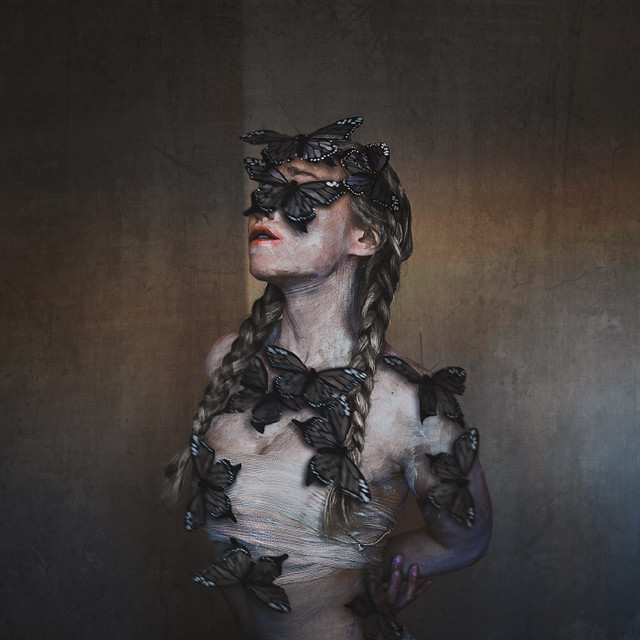
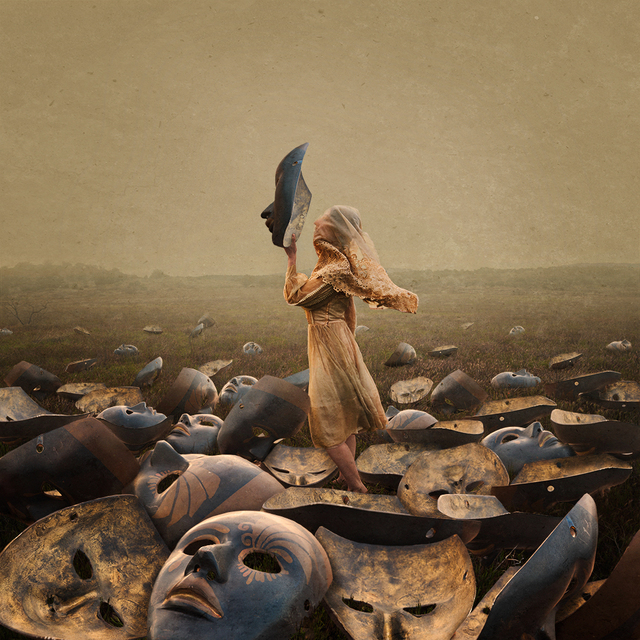
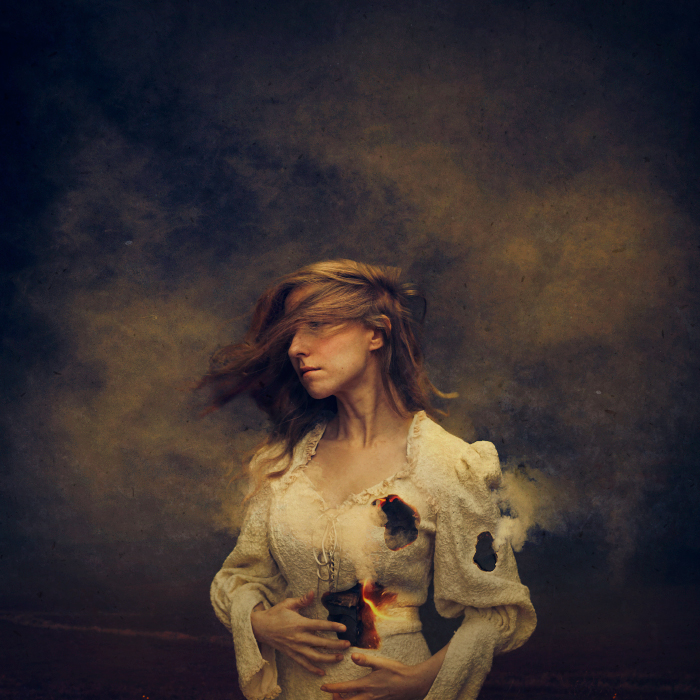
I know very little about Brooke Shaden accept that her work, though similar to that of Isabelle van zeijl, is driven not by a disturbed past, but by a mind eager to explore her dreams & the wandering of her imagination as a child. Where Zeijl appears to be running from her past, Shaden is embracing and exploring her past. Shaden uses herself as subject, model and photographer. It could be argued that this is not self portraiture, rather that she is modelling for herself! I think however, she is using material and ideas that have come from within her own self, albeit as a child, and is recreating them through the digital medium. In a way she is taking up from where she left off as a child, taking the dreams and products of her child play, and running with them, trying to organically develop these characters, se where they go and what they become.
Of all of these artists I think Shaden is the least narcissistic of all. In a way she is along for the ride, seeing where things take her, rather than trying to specifically express or portray. The core values and starting points of all of her work is rooted in child dreams and imaginings. I also feel that all of her images can be understood with limited knowledge of what has gone before. Even without foreknowledge it is clear to see the dreamlike qualities of her work. Yes a lot of it is dark, and some of it is disturbing, but not exclusively.
More often than not her go-to format is square. This I think fits nicely with the content being ‘of dreams’. The viewing of a square image is much less structured than that of a rectangular image. Also, as is often the way with Shaden’s work, the negative space brings so much more to the image, and this works very well within a square. Negative space in Shaden’s work really helps, or is maybe even the cornerstone of what gives her work mood or atmosphere.
Interestingly, one of the key things that drives her is her passion to pass on her enthusiasm to others, to encourage others to take up the baton and run!


4th July 2020
Isabelle van zeijl
From such personal trauma there grew a preoccupation with things that were beautiful, a logical escapist impulse. For Van Zeijl, during childhood, this meant poring over books on Renaissance art and fashion magazines she found at home. These early experiences with idealized aesthetic images still very much influence her work today. “These are the layers you can recognise in my work. I have snippets from Frans Hals or Rembrandt, but also from fashion photographers, Kate Moss and other fashion models. I’m highly inspired by Alexander McQueen, of course. He also makes, out of dark zones, these beautiful designs.”
Van Zeijl began to play with this idea of autonomy, the blurring of the subject with the object. As such, she ends up occupying every role in her own process of photography. She is photographer, model, set-designer, director, all in one. In a sense, she’s fulfilling the societally imposed dream of “every little girl” – to be on the magazine cover – but in another sense, she’s making a point about exposure, tenderness, strength, and self-fulfilment.
https://www.mutualart.com/Article/-Out-of-Dark-Zones–These-Beautiful-Desi/6907C5F2A4C93B4A


29th June 2020
Samantha Gaballe
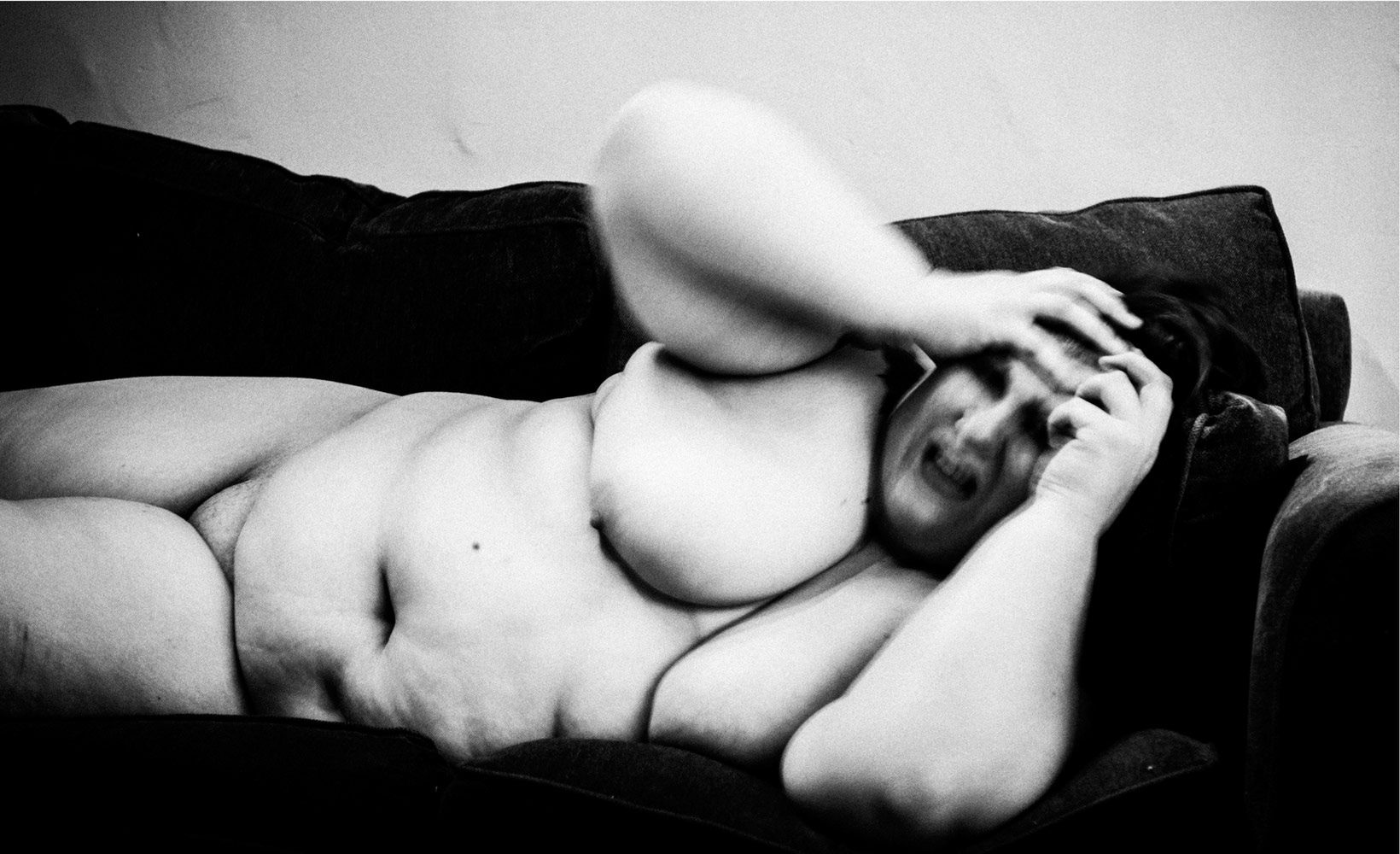
Her seminal work was & is Self-Untitled. Up until the age of twenty-six SG was ‘super morbidly obese’. She had bariatric surgery, a gastric bypass, and then started to lose the weight. In her own words, “Self-Untitled began out of sadness, pain, and anger. Emotions I felt constantly (and still do) about the way I was being treated by others and the way that I treated myself. My eating disorder was destroying my life…”. Like so many of us, she found it difficult to ask others if she could make an image of them. Unlike so many of us though, she was able to not only turn the camera upon herself, but divest herself of all of her clothing. The enormity of this decision to leave herself nowhere to hide shows the true strength of character she has. This I think is born out of the constant bullying that she endured.
I would really like to document my own, aging body, but as yet don’t possess the strength, resolve or just plain balls, to do so. By reading about and studying the work of SG over and over again, I hope to find the courage within to one day start. At the moment I am still hiding behind excuses such as “I have to have something strong to say”, “people will think I’m just an exhibitionist looking for any flimsy reason to disrobe”.
SG goes on to talk about where her drive has come from and how she has been able to create something way more than what many may see as a sideshow freak. She brings humanity, pain, love and an entire gamut of emotions to her work, something that at this moment in time I feel is way beyond me.
“Something my mentor has taught me, is that some of the best creation comes from limitations. Make a portrait that includes water. Make a portrait that includes motion. Make a portrait that is two in the space of one. Now, how do I play with these rules? How do I break the rules? (I always want to break the rules) How do I push myself to make imagery that matters? How do I make someone care? I have to put myself inside of the box in order to get out of it.” An incredible journey in such few words!
SG talks about conveying feelings and letting people in, and trying to make the intangible tangible. If I don’t have said feeling or a sleeve to wear my heart on, how do I generate something that isn’t hollow and meaningless? She tells us that her images are her mirror and the way she learns herself. I can understand this, and this I can do, but feel that at the moment it is a project that is purely one of self-discovery, much like writing a diary.
In an interview for f.stop magazine, Sarah Hadley asks;
Your work is very brave as it is about your own life, struggles and you portray yourself naked and vulnerable. Did this evolve or were you always this honest or able to put yourself out there?
Samantha Geballe: I have a hard time believing my work is brave. I think it’s necessary and I wish more people would reveal themselves. I think most people haven’t a clue who they are. They’ve never seen themselves before. Something I’ve learned in taking nude self-portraits is that people are completely enamoured with authenticity as long as it isn’t their own. What’s so difficult about showing your true self? If others don’t like you, what do you make up about you?1
Not brutal, harsh, resentful or angry, just honest and direct.
And finally:
There are subliminal gender-role fuck-yous in my photographs. I sit in front of the camera as I take pictures and think that no one should be in control of what I look like, how I chose to be myself, and who I fall in love with. I find release and relief in throwing my chest high in the air as I fire the shutter. I find courage in sitting in a chair in front of my camera, legs wide open, because I can and I should. I have to photograph myself now, and it’s not an option to stop anymore, even if the photograph is only for myself. I want others to know that I am an acceptable human being, even with the miles of excess skin I wear around my body. The excess skin shows the journey and life I protected myself with and the wall I built to survive. It is my body, and it is beautiful regardless of how I or others feel about it. It has to be, even though I am still at odds with it at times.2


Reference
- https://www.fstopmagazine.com/blog/2016/10/interview-with-photographer-samantha-geballe/ Posted on October 1st, 2016 by Sarah Hadley
- http://www.strangefirecollective.com/qa-samantha-geballe By Hamidah Glasgow | August 23, 2017
21st June 2020
Elina Brotherus B-1972
- Contemporary photographer.
- Many images carry a depressing feel to them. This represents her anguish for not being able to conceive naturally or with IVF.
- Pictures cover her experiences through life.
- Her project Model Studies are a good example of questioning the ‘role of the artist’s gaze.
- Uses the camera as an investigative tool.
- “Involuntary childlessness”
- She talks almost with bitterness about the avoidance/non acceptance to talk about fertility. She has become a leading voice the means of ‘art’ to stand up and speak from a woman’s point of view about the subject. She sees ‘Involuntary childlessness’ as a taboo subject , which I think, understandably, angers her.
Elina Brotherus’ seminal body of work ‘Annonciation’1 is a ‘No punches pulled’ photographic account of her five years of unsuccessful IVF treatment program.
The title, a clever play on ‘Annunciation’, the announcement by the Archangel Gabriel of the pregnancy of the virgin Mary. My understanding of the title being that of a derivation/bastardisation of anonymous.
Brotherus takes us through five years of heartache and frustration, but she also has anger and frustration at the way the (all forms of) media deliver their features on IVF (In vitro fertilisation). “What we learn about the subject in the media – documentaries, interviews, articles and TV programs on infertility – they all have a happy end. In reality, the success stories are rare, but they are the ones we hear of. For the rest of us, this biased broadcasting is upsetting. It’s as though the general public should not see the inconsolable reality but instead a cathartic ‘per aspera ad astra’ Hollywood story.”1 This is the vehicle that drives this body of work so far off of the path well-trodden. Though this work is, in itself far reaching, it is merely opening a door on a subject which is vast, complicated and mostly uncharted. By drawing on courage from somewhere, Brotherus presents us with a series of self-portraits which (cliché, but true) lay her soul bare, at her most vulnerable and emotional times.
This series prompts me to think about the dichotomy that exists in portraiture, or the ‘capturing of the person’. More often than not portrait artists are trying to capture ‘that look’ or ‘that instant’ when the sitter bares their soul or drops their guard. Yes, that is very hard, and indeed an art, however Brotherus throws these notions of difficulty out of the window, by capturing something far deeper, even though the emotion is thrust upon us.
Reference
30th May 2020
Francesca Woodman B-1958 D- 1981 Aged 22
- Explored gender representation and the use of the female body.
- 500+ self portraits often dark and disturbing.
- Metaphysical
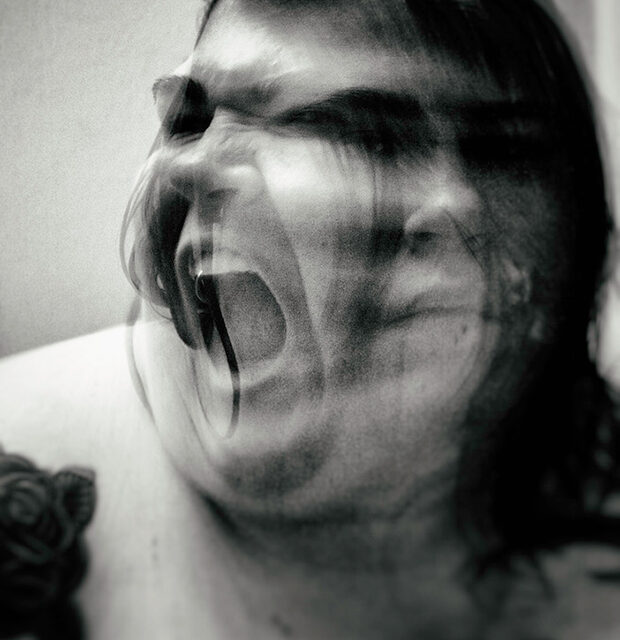
- Often used blur/movement/slow shutter speeds to….. Possibly hide herself, represent self loathing? Or even artistic surrealism.
Evidence to back up Bright’s analysis. Sadly, there is no evidence to back up Bright’s assumptions. Francesca Woodman took her own life at the age of twenty-two, less than a year out of college. It is known that she suffered from depression, having already failed to take her life a year before. Some of her images are dark and sometimes disturbing, but reading the things her parents have said, also suggests that she had a good sense of humour which often came through in her photographic work. We have to remember that her work never came to prominence until long after she passed away.
The people best placed to comment on her work and the link to her mental stability are her parents, and the people that knew and interacted with when she was at college. It is said that at college, she was, if not a loner, then somebody that was more consumed or passionate about her work than social interaction and the acceptance of her peers. She had a number of close friends, one being Sloan Rankin. When she asked Woodman why she was so often the subject of her own photographs, Woodman replied ‘It’s a matter of convenience, I’m always available’1.Rankin, I would say would be able to offer the most balanced of opinions. I think that her parents’ views are also not to be ignored. It is all too easy to put your offspring on a pedestal, but their views are balanced and honest, coming from an artistic professional background. Rachel Cooke tells us “Their memory (FW’s parents) of Francesca is that she wasn’t a “deeply serious intellectual”; she was witty, amusing. “She had a good time,” says Betty. “Her life wasn’t a series of miseries. She was fun to be with. It’s a basic fallacy that her death is what she was all about… They’re often funny (F Woodman’s images). The photographs in Zigzag include playful visual jokes: a pair of fingerless “gloves” made from the bark of tree and modelled by Francesca, whose arms are raised so as to resemble the spindly trunks of the birches nearby; a disembodied pair of legs mirroring a charred-looking V-shaped groove in the ground, as if her body left this impression behind when she unaccountably fell to earth.2 I think that FW would have had frank and honest conversations with her parents, given that they were all artists. Another close friend of hers, Betsy Berne, agrees with her parents that too many people have a blinkered view of Woodman’s work, that of being a portent of what was to come. She also tells us of the wit and humour that exist in her imagery. These are all the opinions of people that knew her, who have based everything they say on fact and recountable stories. It is Berne that offers us the most frank and direct thoughts. Unflinchingly, she says “She had an illness: depression. That’s all there is to it.”2 This is in answer to the suggestion that her suicide was in response to being turned down for a funding application.
I think too many people take either an image in isolation, or a ‘genre’ of her work and focus to the detriment of all else on this. Her work is so unusual and varied in content that her life work needs to be viewed as a whole to get a feel for the ‘real’ Francesca Woodman.
Her work was both light & dark, and fused together with a lot of surrealist symbolism, such as fish & birds, also heavily featured is the use of mirrors. In much of her work can be seen the influence of Man Ray, a leading light in the early surrealist movement himself.
The final entry in her journal reads: “This action that I foresee has nothing to do with melodrama I was (am?) not unique but special. This is why I was an artist…I was inventing a language for people to see the everyday things that I also see…and show them something different…Nothing to do with not being able ‘to take it’ in the big city or w/ self-doubt or because my heart is gone. And not to teach people a lesson. Simply the other side.”3
What we lost was a prolific talent, somebody that produced in the first twenty-two years, what other accomplished artists would fail to achieve in a lifetime. We can only wonder what would have followed, had she not succumbed to the effects of depression.
Reference
- (quoted in Rankin 1998, p.35).
- Rachel Cooke. 31st August 2014. Searching for the real Francesca Woodman. The Guardian/Culture/Photography
- Julia Fiore. 22nd August 2018. Reevaluating Francesca Woodman, who’s early death haunts her groundbreaking images. Artsy.net.
 I see!