 1
1
 2
2
 3
3
I wasn’t entirely sure how to correctly approach this exercise. So initially I placed my ‘point’ in a set position and then took a series of photo’s whereby I moved the frame around. Having reread it a number of times, I then decided that the correct way was to set the camera up and then take a series of pictures with the ‘point’ in different places in relation to the frame. With my first set of ‘correct’ images I then found that the item was just too small to attract the eye. Finally, I think I got it right!
So, evaluating the pictures! The criteria for (small yet clear, and not in an obvious place) the point has now been met, What are my thoughts on each of the images? And what are my thoughts on the images in relation to each other?
As the point has been randomly placed, the only reason that the eye is attracted to it, is because it is bright in comparison to the rest of the image (particularly in image one). In image two, the point is situated in a small corridor between the edge of the frame and what is possibly the most interesting thing in the frame, the vehicle. Image three is probably the least obvious as it is closer to the dark and dirty corner of the image.
All of that said though, I asked individual members of my family to look at the images one at a time and tell me what they saw. Obviously the first image was the one which would have the most significant response. All of them alluded to the piece of paper (the ‘point’) being something that stood out (disproportionately).
I then went on to conduct a similar experiment, only this time the point was purposely placed in positions that ‘worked’ within the framework of the image. Or rather to prove that you can actually place a point anywhere within the frame and (I think) it will work. The point stands alone, and in itself has no direction or implied movement, yet it commands your attention much more forcefully than its larger, more showy cousins the lines and curves.
 1
1  2
2
 3
3  4
4
Take these four images above. even when further away and marginalised, the point in image three still commands your attention. If a horizontal or vertical line were to be framed so close to the edge of the image, it would lose a lot of its importance and quite possibly be overlooked. Not so with the point. When placed in an expanse of plain space, it becomes stronger still, it has a stage! When a point is placed close to the edge of a frame, it feels as though it is giving off an aura which links to the side of the frame, drawing things in from around it to support and embolden it. The point seems to grow in a magnitude disproportionate to its size, eclipsing bigger entities that are close by. It would seem that there is no place within a frame that you cannot place a point, and it look wrong.
 1
1
 2
2
 3
3
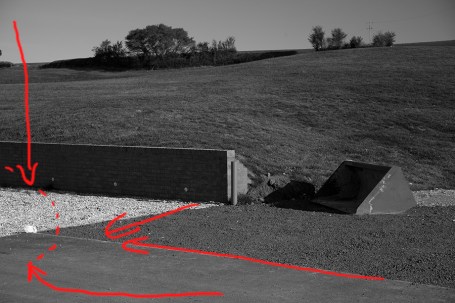
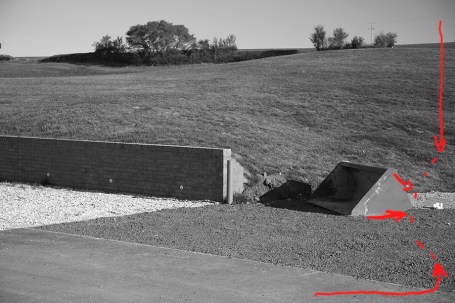
The three images above have red arrows on them to show the route that the eye naturally takes to arrive at the point. In image one, the point is almost in centre of the image. This is acting like the centre of a black hole, no matter where you start looking at the image, your eye takes route one directly to the centre. There are a couple of bold diagonals which also direct the eye to the centre too. The point in image two is marginalised, way over to the left. Again, there are a couple of diagonals which guide you straight to it, but it is also drawing the gaze from above, dragging your eye down the side of the image. It creates a ‘ballooning’ of interest safe and secure at the edge of the page. WIth image three, again the point is right at the edge of the page, but as you can see, your eyes are naturally drawn to it, highlighted as it were by a couple of very small diagonals, but once again growing in strength due to its proximity to the side of the image.
A good photograph should lead your eye on a journey through the image, telling a story or asking questions as you go. When you compare different photographs, you should also notice that each image will have a different tempo (possibly even speeding up or slowing down). The images of mine below show the journey that my eye naturally takes. The tempo of both images is quite sedentary, but this is in keeping with the subject matter, so I am happy with this.
 1
1 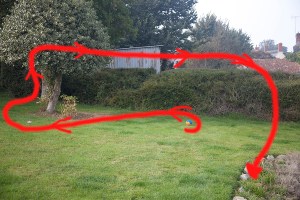 2
2
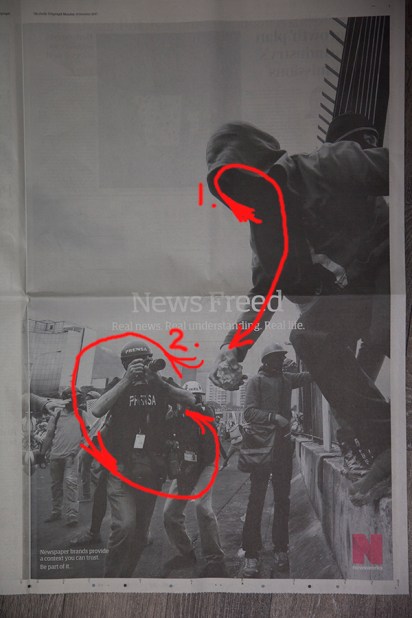
Below are another couple of images which I have taken from Monday 9th October 2017 copy of ‘The Daily Telegraph’ (Business supplement. Image 1 is the property of ‘The Press Association’, the other I cannot see a credit for). The first image as a sustained medium/fast tempo about it which is accentuated by the flag. I have drawn on the image how my eye has travelled through the picture, and I have been left with a pleasing rhythmic feel to the image.
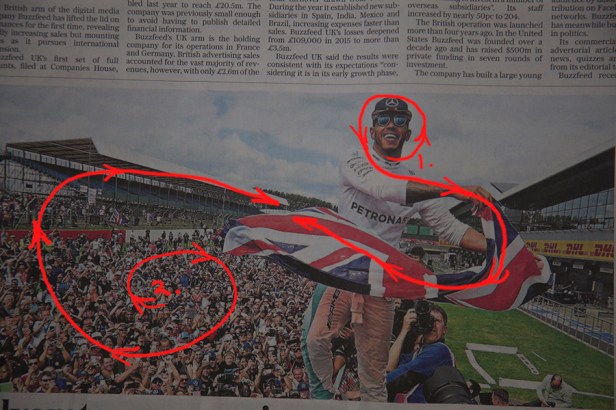
The next image is an image of conflict, and although it is difficult to see from this reproduction, the two different journeys that my eye take, are separated/joined by a ‘point’ created by the white helmet of the second photographer. I don’t believe that there was conflict between the person in the foreground and the 1st photographer, but the composition of the image and the position of the point certainly give a feel of a ‘coming together/clash’.
Exercise 1.2 Point. Contact sheets
 I see!