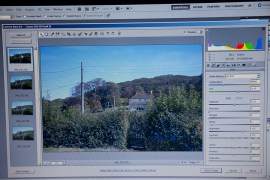
The object of this exercise is to demonstrate exactly how sensitive the DSLR camera really is, or more precisely, the camera’s sensor is.
These four images look exactly the same.
 1
1  2
2  3
3  4
4
The camera (Canon 5d MKII) was mounted on a tripod and the ‘fully auto’ mode selected. All four shots were taken using a Canon EF24-105 lens, auto set to f4 @ 50mm. The weather conditions on that day were fair, with little wind or cloud. The frames were shot at 12:46:30, 12:46:37, 12:46:41 & 12:47:09 respectively (A total time frame of 39 seconds). All that said, as you would expect, the images are almost identical. However, when you look at the histogram it is clear that the camera’s sensor (capable of measuring the tiniest of changes) has registered some very noticeable changes.
 1
1 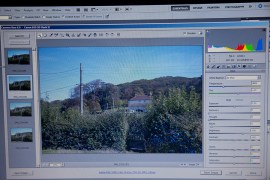 2
2 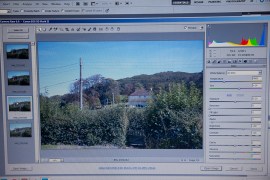 3
3  4
4
When the images are examined closely, it can be seen that some birds have flown across the picture, and that there is a subtle, almost indiscernible change in the colour of the sky (Cloud across the face of the sun?). This has all been registered by the sensor inside the camera.
The histogram is a very useful tool (able to convey/display an awful lot of information) and can help the photographer both on set and in post production. Once you are able to ‘read’ the histogram, this allows you to make fine adjustments in ‘Levels’ within your chosen post production software package.
This camera (although not ‘cutting edge’) can most definately be regarded as ‘hyperfunctional’. In truth, most cameras will have been hyperfunctional at some point in their day. Certainly all but the most rudimentary DSLR’s can be classed as hyperfunctional. It is human nature to want to improve upon and advance technologically, that which has already been invented. We’ve come a long way since Fox Talbot produced his photographs!
A visit to Lacock Abbey near Chippenham, Wiltshire is well worth the time. It was the home of William Henry Fox Talbot, who is often credited with having produced the first ‘real’ photograph (involving printing a light fast, permanent, ‘positive’ image onto paper from a negative). The latticed window which is credited with being the subject of the photograph produced from the oldest existing camera negative can be seen at the abbey. There is also a very informative and fascinating (small) photographic museum there too. Not to mention the exhibitions that are frequently put on. If you are a member of the National Trust, parking and entry are free.
 I see!