Part 1
In an attempt to find out what would be the shortest timeframe that I would be able to discern detail in daylight, I dusted off my old Olympus OM10. I fitted a new battery to it and, having checked that there was no film in it, opened the back. I have to say at this point that I had fitted to it the plug on shutter speed manual adapter to make this experiment possible. The fastest speed was 1/1000th, which I had no expectations of seeing anything at. I was right! Each increment halved the speed, so the next one I tried was at 1/500th. Obviously I was aware of an actuation taking place, but was again unable to register what I was looking at. Dropping down next to 1/250th, the speed change was nearly discernible, and the result the same. At 1/125th the sound of the shutter was slower, but I was only able to make out the basic tonal change. At 1/60th things were getting tantalisingly close, and at 1/30th I was able to start figuring out what I was seeing. I would say though that it wasn’t until I dropped it right down to 1/15th that things were clear enough for me to see, and even then I had to do a couple of repeat shots to fully appreciate what was there to see.
Part 2
In this exercise, the object is to take in the whole of the image, breaking it down into foreground, middle ground and background before taking the shot. By doing so you are able to see everything and not overlook certain things. This strengthens the image by focusing the mind on, and so improving composition. Until now, I have concentrated mainly on a single object, and where it is, compositionally, within the frame. The shot below was not even on my radar when I read the exercise, but having visualised and taken the shot I had in mind (see image 2), I knew from the structure of the exercise that it wasn’t very strong compositionally. Walking back to the car, with my mind tuned in to what was needed, I was able to see this shot (image 1) working quite well. The light quality wasn’t the best on the day, and so the vibrance and sharpness drop off quite quickly, but I think the composition is strong. I used an app on my phone to calculate the settings required to get the maximum depth of field from the closest point to the camera. In the foreground there is the bank and the fence leading the eye to the right the tree in the middle ground, with the faint white buildings of Hinkley Point nuclear power station framed nicely between two fence posts on the horizon.
 Image 1
f22 @ 1/60 sec. ISO 800, Focal length 40mm, Distance to subject 4.5m.
Image two was the first shot I took, but it is clear to see that, even with a more interesting subject matter (a disused tin mine) because there is nothing in the foreground, the image is disjointed and lacks cohesion, even with the same background as image one.
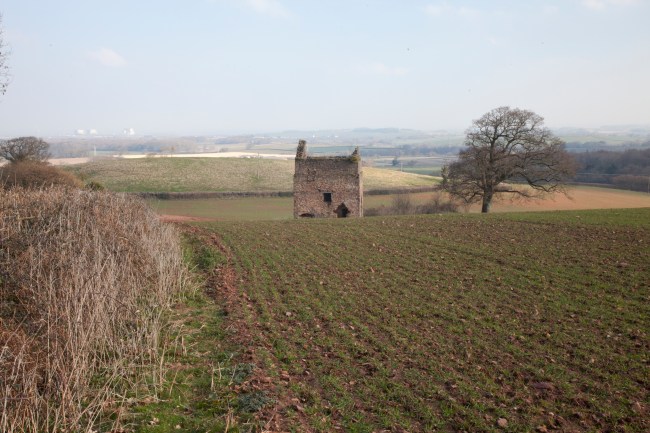 Image 2
f22 @ 1/20 sec. ISO 800, focal length 40mm, distance to subject 4.5m.
 I see!