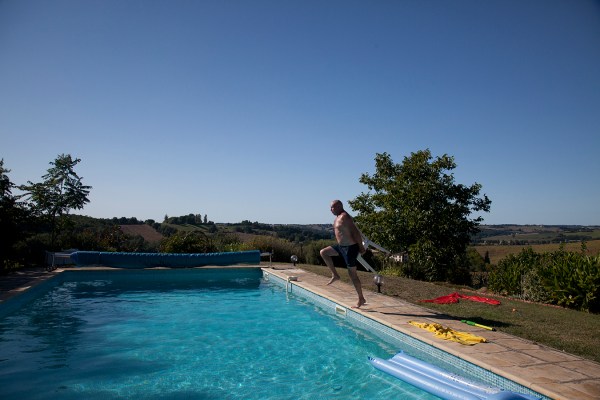
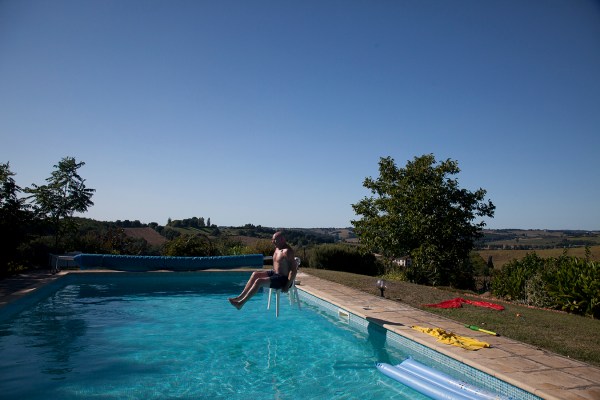
This series of shots were taken just before I started the course. They are light-hearted but still highlight something quite interesting. You would think that the best one would be the one showing impact with the water, however I think the best one is number three, which appears to show me sat on a chair which is floating on the surface of the pool! Obviously this isn’t the case, but it does show that timing is everything.
All four images have identical camera settings as the camera was tripod mounted, the camera set to ‘continuous shooting’ and shot remotely.
f8 @ 1/1500 sec, focal length 24mm (24-105mm zoom), ISO 800, subject distance 6.5 metres.


The following shots show my attempt to carry out exercise 3.1
The idea was to show water filled balloons exploding when dropped from a height. I spent a little while working the shoot out in my head, and this paid dividends, as I was able to get close to the shot that I had in mind straight away. From this good starting point I made a couple of tweaks to arrive at a satisfactory image at the end of the shoot.
Image 1. Shows the basic set-up for the shot. I set up a black backdrop which I hoped would help to accentuate the light being refracted from the two studio lights. I set up a lectern with the head laid flat. On that I put a small spike made from a straightened out paper clip. I set the tripod up at what I thought would be a safe distance from the water and did a test drop. The set up was perfect, with the exception of a little water hitting the inside of the light heads (which wasn’t an issue).

I thought that the main problem would be timing the shutter release with the impact of the balloon on the spike. This didn’t prove to be a problem at all. The main issue was getting the remote to talk to the camera consistently, I think this was just a low battery issue though. Looking through the contact sheet you can see how many test shots there were between each drop.
The biggest technical disappointment was that even though I was shooting in natural light it was a little overcast. This was enough to force me to use a very high ISO’s (3,200-6,400 & 25,600) which were reflected in the poor grainy quality of the images. The image below is a good example of this. The water splash is frozen yet it does not appear sharp, which is due to the excessively high ISO.
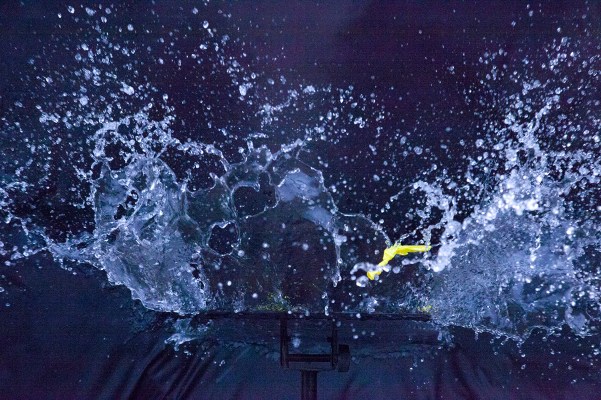 f6.7 @ 1/1000 sec ISO 25,600
It wasn’t all plain sailing on the accuracy front either!


After a short while I began to think that perhaps I could get the water to sparkle a little more if I pointed the lights on the bombs from a more frontal position. So I changed the set-up slightly.

As you can see from the results below, being able to freeze a scene which would normally be happening faster than either the eye can register or the brain comprehend, reveals some quite intriguing displays. Unfortunately the backdrop is a normal thin cotton bed sheet . Ideally using a heavy velvet cover would produce a more uniform and darker background which would in turn accentuate the light registering on the water formation.
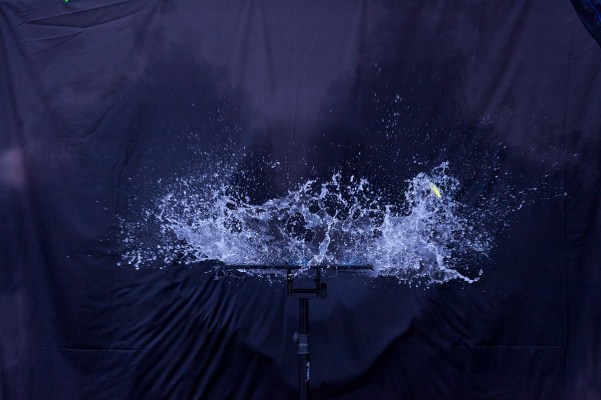 f5.6 @ 1/1000sec, 50mm, ISO 3,200
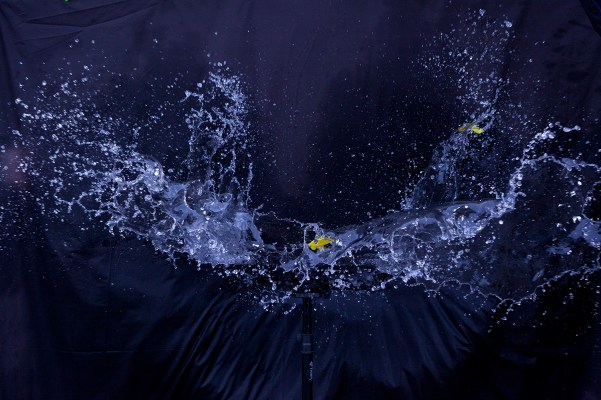 f6.7 @ 1/1000sec, 50mm, ISO 3,200
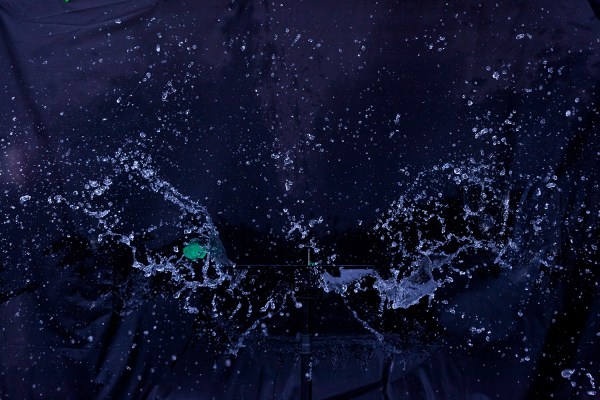 f6.7 @ 1/1000sec, 50mm, ISO 3,200
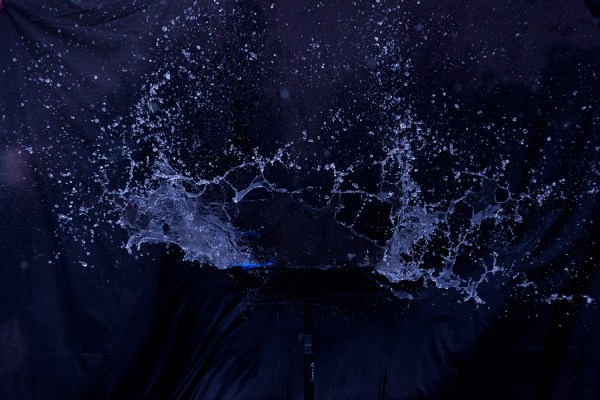 f6.7 @ 1/1000sec, 50mm, ISO 3,200
 f6.7 @ 1/1000sec, 50mm, ISO 3,200
In answer to the question “Does the camera capture movement ………… or does it fragment it, as Szarkowski believed, isolating thin slices of time to reveal something new?” I think that this is merely two ways of describing the same thing. Looking at the images above, it is clear to see that there was movement taking place at the time the image was captured. However it can also be said (not argued) that the smallest fraction of a second either side of any of the above images would be noticeably different from both of its immediate neighbour, rather like the slices of a loaf of granary bread. Whatever the thought process of such images, the end result is always a visual feast.
Over all though I felt that I was successful in achieving what was asked in this exercise, and that was; trying to isolate a moment in time using a fast shutter speed on a moving object.
 I see!