The Brief
Revisit one of the exercises on daylight, artificial light or studio light from Part Four (4.2,
4.3 or 4.4) and prepare it for formal assignment submission:
• Create a set of between six and ten finished images. For the images to work naturally
as a series there should be a linking theme, for instance a subject, or a particular
period of time.
• Include annotated contact sheets of all of the photographs that you’ve shot for the
exercise (see notes on the contact sheet in Part Three).
• Assignment notes are an important part of every assignment. Begin your notes
with an introduction outlining why you selected this particular exercise for the
assignment, followed by a description of your ‘process’ (the series of steps you took
to make the photographs). Reference at least one of the photographers mentioned
in Part Four in your assignment notes, showing how their approach to light might
link in to your own work. Conclude your notes with a personal reflection on how
you’ve developed the exercise in order to meet the descriptors of the Creativity
criteria. Write 500–1,000 words.
Include a link (or scanned pages) to Exercise 4.5 in your learning log for your tutor’s
comments.
Assignment four (PH4EYV-4)
Languages of light
I chose to shoot natural light after getting up late one evening, unable to sleep. It was a particularly bright full moon which drew me into the garden. Some areas were so well-lit that I wondered whether it would be possible to capture anything with the camera. I took about forty random photos and then reviewed the results. They showed that there was potential for creating something quite different.
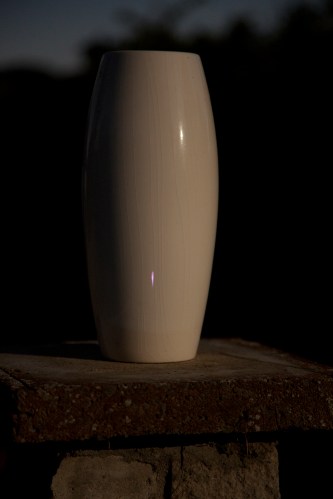
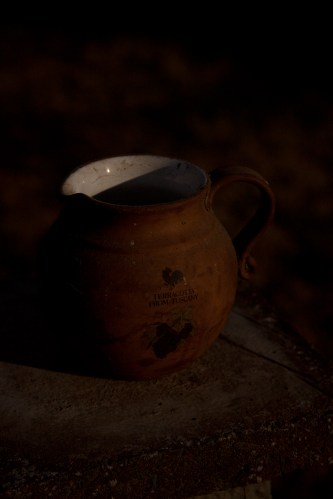
The light quality from these images reminded me of some of the work of Eugene Atget, which I had been studying. In particular, his work in the Parc de Sceaux1. Some of these had a wonderful ethereal quality which suggested it had been shot by the light of the moon. This inspired me to shoot the female form by moonlight, a kind of homage to Atget’s statues. The main issue was always going to be ‘movement blur’ which I was going to have to either embrace or find a way round. Off of the back of this I thought also that it would be good to shoot something akin to the marble or alabaster statues in Atget’s photographs, and so the second part of my shoot incorporated some pottery from around the house.
Brian Bowen Smith once carried out a project2 where he shot a series of photos of female nudes wearing masks. Wearing them gave the models total anonymity, and in doing so relaxed them and produced more natural poses. This fits nicely with the codes and conventions of portrait photography which dictate that a portrait should, in the words of Inge Morath ‘catches a moment of stillness within the daily flows of things, when the inside of a person has chance to come through’3. I decided to employ this technique too, even though it would isolate and partially obscure the eyes which normally add so much to a portrait.
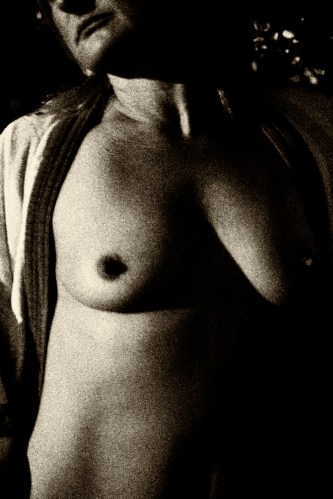
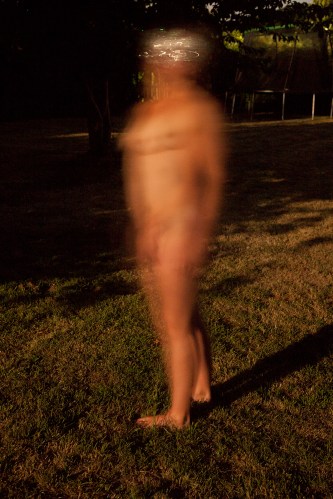
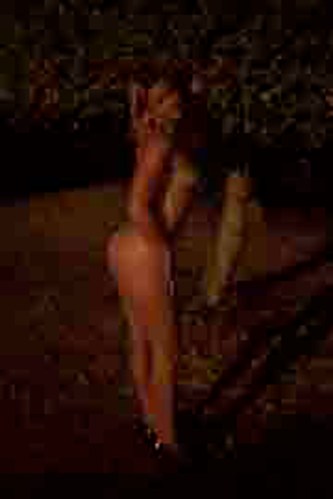
The process used for each of the two subject matters varied considerably. I wanted to keep the nude images clean and sharp, but with shutter speeds of 9 seconds and an ISO of 64,000, this was not possible. Giving myself up to serendipity allowed me to think a little more freely and experiment with other ideas. I asked the model to move her body whilst the shutter was open, creating some interesting results. I also tried accentuating the noise, and converting it to black and white. Although deviating from my ‘lit by the light of the moon’ theme I feel that the B&W image was a success. The inspiration for this was drawn largely from the work of Bill Brandt4, who excelled in creating works of abstraction by the combined use of high contrast black and white, extreme perspective and graining. To complete the nude set I made use of the technique of Thomas Ruff, whereby an image is heavily pixellated, forcing the viewer to examine, read & interpret an image for themselves.
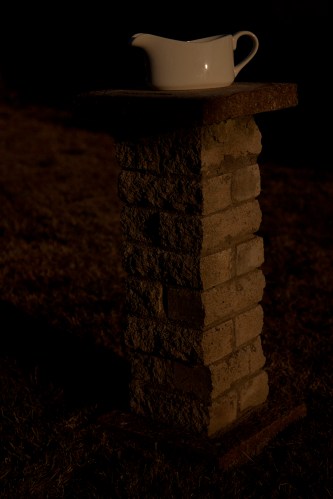
Shooting the pottery was surprisingly, more involved and difficult to get right. This was because there was no reason for the images not to be pin sharp as both the camera and the subject were static. Even though the light of the moon was good, looking through the viewfinder registered nothing and so made it very difficult to focus. This was overcome by using the light from my mobile phone shining on the subject. To get the image pin sharp I then had to switch to ‘Live image’ mode to view on the camera screen, then, magnify x10 and fine tune the focus from there. The biggest drawback for this assignment was the slow shutter speed/high ISO required to record any information. Using settings of ISO 6,400 and an aperture of f4, I still had to keep the shutter open for in excess of sixteen seconds. Given that there was a slight breeze, I felt that dropping the ISO and increasing the time the shutter was open still further would increase the likelihood of blur through camera movement, so this avenue was not investigated.

MB001.PH4EYV-4 MB002.PH4EYV-4
MB004.PH4EYV-4 MB005.PH4EYV-4
MB005.PH4EYV-4

MB006.PH4EYV-4
MB007.PH4EYV-4 MB008.PH4EYV-4
Reflections on this assignment
From the beginning of this assignment I have been very happy with the creativity involved in its production. It can be quite a struggle to come up with an original theme for many assignments, but I stumbled upon this theme quite by accident. In doing so though, I undertook an enjoyable set of problems and challenges which I feel I worked around and overcame. Using a live model was a challenge, particularly communicating how I wanted her to pose, given that what translates into an image feels very different and awkward as the poser. Overcoming the issue of trying to get perfect focus on the earthenware was very rewarding as it turned into a series of steps to overcome just one issue. Over the course of the shoots, it became clear that everything was about experimenting and learning from each mistake, or tweaking to get what is seen in the mind’s eye. In light of this, there is still a lot to be learnt and I am eager to return to this concept.
Having now freed myself of the notion that my images have to be pin-sharp I can explore moonlight in a less formatted or ‘strait’ way.
In exercise 4.5 https://eledhwen.blog/exercise-4-5/ I have demonstrated (last image) that sometimes, to create a seemingly simple effect, you have to do a lot of ‘behind the scenes’ work to convey an idea, which at concept, seemed quite simple to produce.
References
- https://www.moma.org/collection/works/39451 Atget, E. 1925. Parc de Sceaux. Abbott-Levy collection. Partial gift of Shirley C. Burden
- Roberts, W. (2017) ‘The life of Brian’, Professional Photography Issue #19
- Graham, The Photograph, Oxford University Press, 1997, Page 101.
- https://www.moma.org/collection/work/48023 Brandt, Bill. 1959. East Sussex Coast
Miles Butteriss. Student 517085
 I see!